
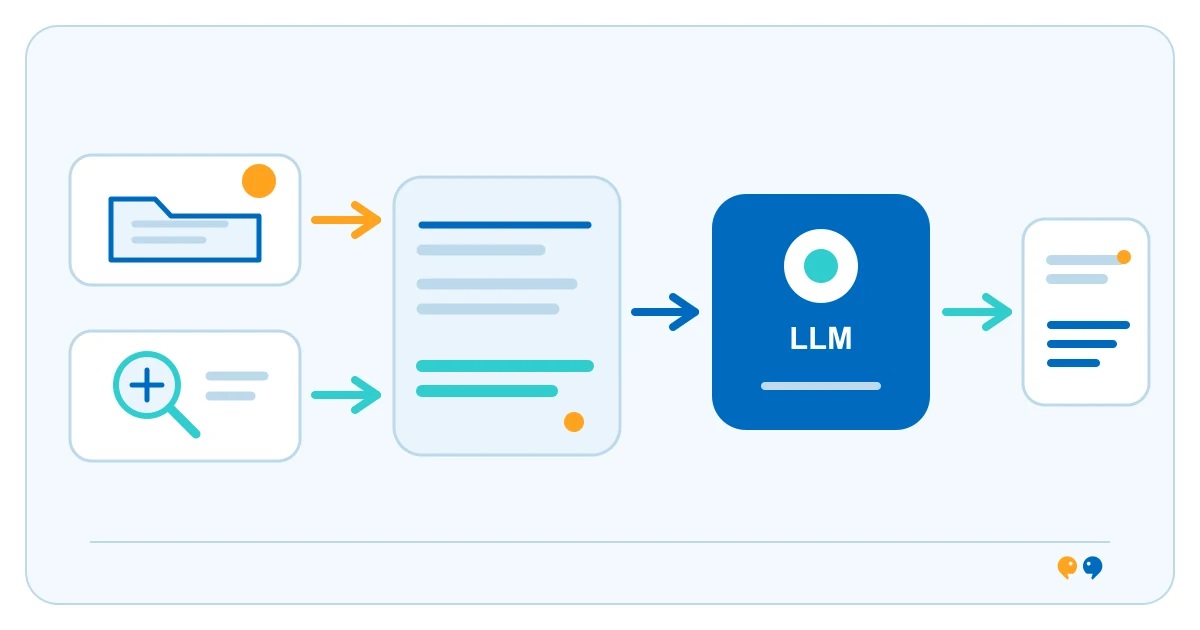
Retrieval-augmented generation (RAG) is a method that retrieves relevant information from an external source and supplies it to a language model when generating an answer. It combines retrieval with text generation so a response can use selected material beyond the model’s built-in parameters. The original RAG research paper describes this combination as a model with access to explicit, non-parametric memory.
How RAG works
A system first prepares source material for search, often by splitting documents into passages and creating an index. When a question arrives, a retrieval step searches for likely relevant passages. The application then sends the question and selected passages to a language model, which drafts a response. Some systems show references to the material used. The quality of each stage matters: document access, indexing, search, passage selection and the instructions given to the model.
Illustrative business example
Illustrative example: An internal policy assistant could search an approved set of current procedure documents, then draft an answer with links to the passages it found. A staff member checks the source before acting on an unusual case. This example describes a possible design, not a measured result.
RAG, model training and AI agents
RAG supplies relevant source content at request time. Fine-tuning changes a model’s parameters using additional training, while pre-training is how a foundation model learns broad patterns. RAG therefore does not teach a model new parameters, and updating a source collection does not automatically mean every answer will use the newest or right passage. An AI agent may use RAG as one of its tools, but retrieval alone is not an agent. See what an LLM is and what an AI agent does.
Limits to plan for
RAG cannot make missing, stale or conflicting source documents reliable. Search may return irrelevant passages; a model may misinterpret them or produce claims they do not support. References help readers check provenance but do not prove that an answer is complete or correct. Control which sources can be searched, keep content current, test representative questions and make it clear when the evidence is insufficient.
For a service-focused overview, see technine.io’s enterprise RAG and knowledge systems service.
Frequently asked questions
Does RAG train an AI model?
No. RAG retrieves external material and provides it as context when a response is generated. Fine-tuning, by comparison, updates model parameters through additional training.
Does RAG stop hallucinations?
No. Relevant sources can support an answer, but retrieval or interpretation can be wrong. The system still needs evaluation, source controls and review appropriate to the task.
Does RAG always show citations?
No. A system can retrieve documents without showing them to the user. Citations depend on how the application is built, and readers should be able to open references and check the underlying material.
Primary source: Lewis et al., Retrieval-Augmented Generation for Knowledge-Intensive NLP Tasks