
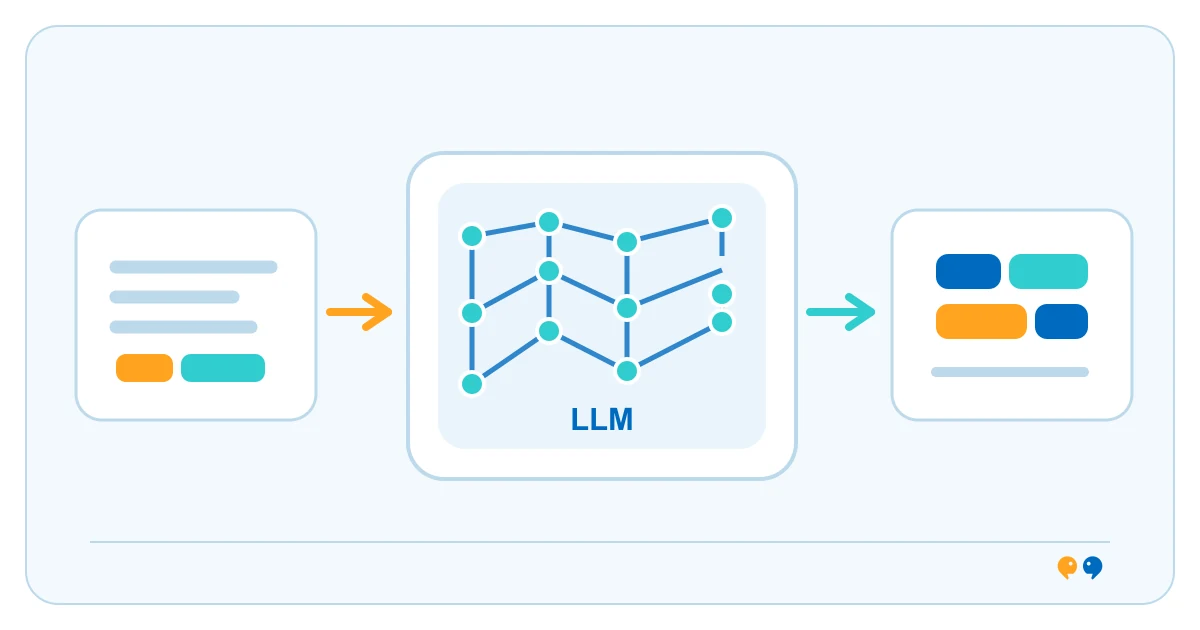
A large language model (LLM) is a machine-learning model trained on large amounts of data to process and generate language. Given an input such as a question or draft, it produces a likely continuation or transformation. LLMs can support tasks such as summarising, drafting, classifying and answering questions, depending on the model and application. Google Cloud’s generative AI glossary describes an LLM as a text-driven foundational model trained on a large amount of data.
How an LLM produces a response
The application sends the model an input, often with instructions and conversation context. The model processes the text as tokens and generates an output based on learned patterns and the provided context. The application can then display, check or route that output. Some models accept other modalities as well, but capabilities vary by model; an LLM does not automatically have live access to company records or the public internet.
Illustrative business example
Illustrative example: A team could use an LLM to draft a first summary of a support conversation, then have an employee compare that summary with the original before adding it to a case record. The model provides a draft; the connected application and staff member determine what information is supplied and what happens next.
LLMs, RAG and AI agents
An LLM is the model that processes and generates language. RAG is a method for retrieving external material and supplying it to a model as context. An AI agent is a larger application that uses a model within a task flow and may call configured tools. The model itself is not a database, a reliable source of current facts or an agent. Learn about RAG and AI agents.
Limits to understand
An LLM may produce an answer that sounds confident but contains errors, omissions or unsupported details. Its response depends on the prompt, context, model and system configuration. It may not know recent information unless the application supplies it, and it does not understand a business rule in the same way its owner does. For consequential work, use suitable source material, test the task, protect sensitive inputs and review outputs before acting.
For a service-focused overview, see technine.io’s AI and intelligent systems service.
Frequently asked questions
Does an LLM search the internet when I ask a question?
Not by itself. A product can connect a model to search or other data sources, but that depends on the application and its configuration.
Can an LLM give a wrong answer confidently?
Yes. Fluent wording does not prove that a response is factual. Check the source material, especially when an answer affects a decision or record.
Is an LLM an AI agent?
No. An LLM is a model. An agent is an application or system that uses a model to work through a task and may use configured tools.
Primary source: Google Cloud: Generative AI glossary