
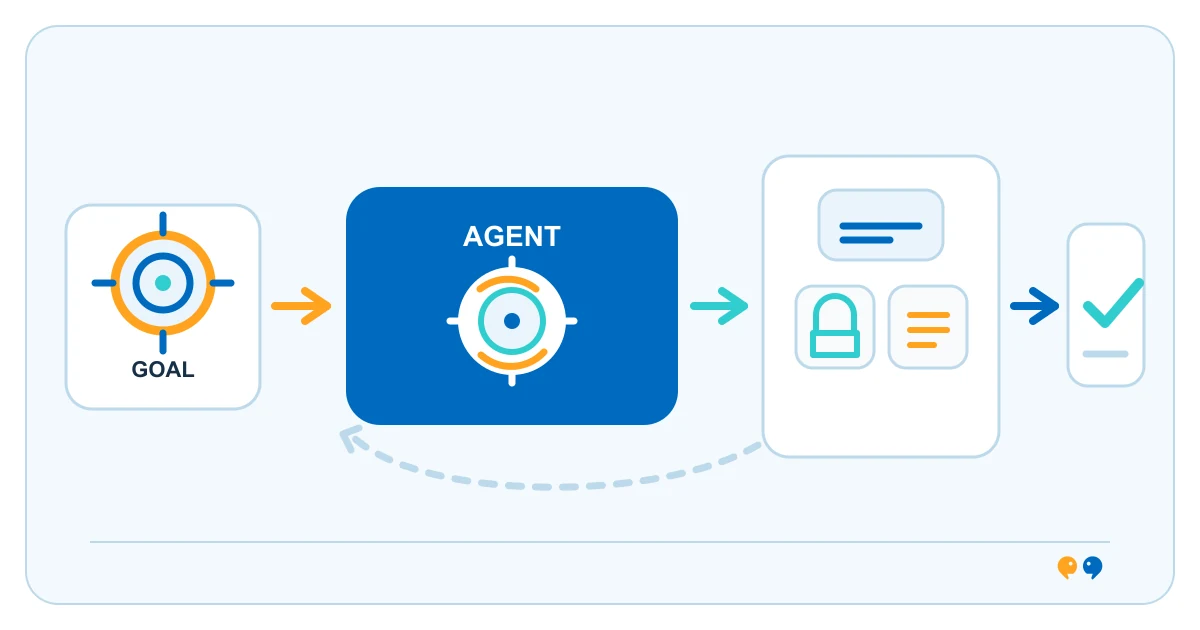
An AI agent is a software system that uses an AI model and available tools to work towards a goal. Depending on its design, it may interpret a request, choose a next step, retrieve information, call a tool and use the result to continue. Some agents handle one bounded action; others coordinate several steps.
A typical setup includes a model, instructions that set the task and boundaries, and tools or connections that let the system access selected information or perform operations. The application decides which tools are available and what permissions they have. In an agent architecture, the model may help select a tool or determine the next step, while application code and policies still constrain the process. Microsoft’s AI architecture overview describes an agent as using a language model to choose actions, tools and their sequence.
How an AI agent works
A user or system provides a goal. The agent considers the instructions and current context, then produces an answer or requests a configured action. The application can run that action, return its result to the agent and decide whether to continue, stop or ask a person. Systems should record what ran and keep permissions limited to the required task.
Illustrative business example
Illustrative example: A service desk agent could read a support request, look up the relevant equipment record through an approved tool and draft a suggested ticket category. A staff member checks the record and confirms the category before it is saved. This describes one possible design, not a Technine customer result.
Agent, chatbot, model and RAG
A chatbot is a conversational interface; it may answer from a model without taking actions. An AI model generates or classifies content but does not, by itself, connect to a company’s systems. An agent adds a goal-oriented control flow and may use configured tools. Retrieval-augmented generation (RAG) supplies selected external information to help a model answer; RAG can be part of an agent, but it does not by itself make a system an agent. An agent may also use an MCP connection or task instructions from an Agent Skill. Read about RAG and MCP.
Limits and controls
An agent can choose an unsuitable step, misread retrieved information or produce an incorrect result. Tool access can also create real side effects. Limit available actions, check identity and permissions, log activity, test failure cases and require human approval where a mistaken action could affect customers, finances or important records.
For a service-focused overview, see technine.io’s AI and intelligent systems service.
Frequently asked questions
Is an AI agent the same as an AI model?
No. A model generates or interprets content. An agent is an application or system that uses a model within a task flow and may use configured tools.
Can an AI agent take actions without a person?
Some are configured to run actions automatically; others only suggest an action or require approval. The available tools and permissions determine what the system can do.
Does an AI agent always need RAG?
No. RAG can provide relevant external information, but an agent may use other context or tools. The design depends on the task and the information it is permitted to access.
Primary source: Microsoft Azure Architecture Center: AI technology overview