
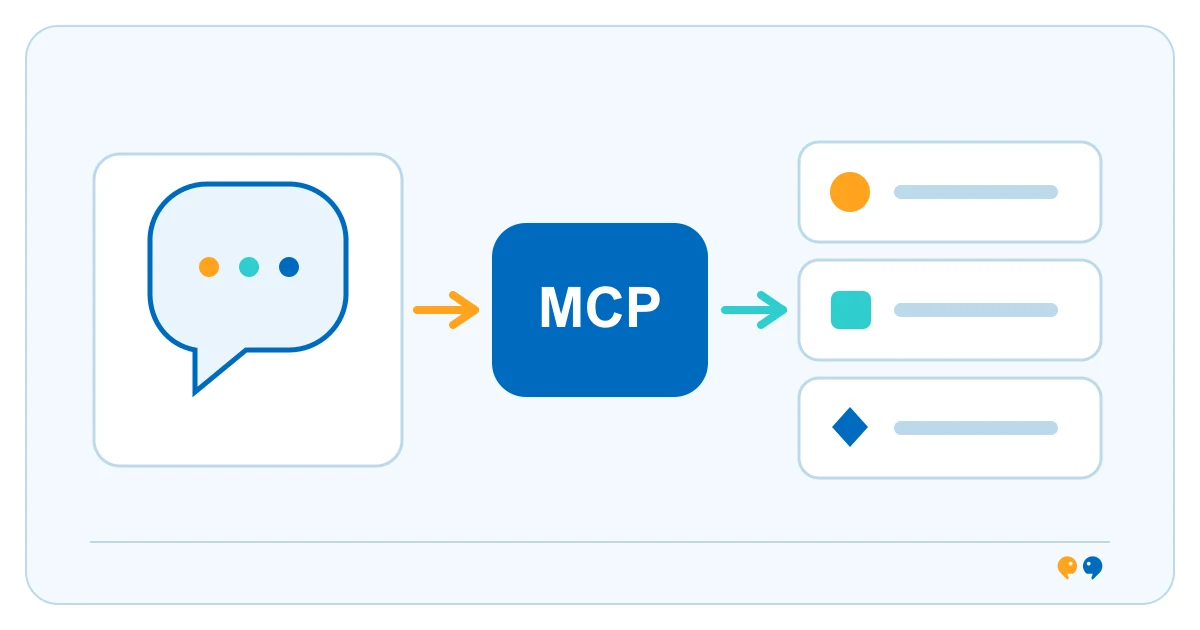
The Model Context Protocol (MCP) is an open protocol that standardizes how AI applications connect to external context and tools. It defines how an AI application can discover and communicate with MCP servers, which provide information or capabilities. MCP standardizes that exchange; it does not dictate how an AI model uses the information.
The current architecture describes a host application, an MCP client within that host, and one or more MCP servers. Servers can provide resources such as data, prompts as reusable templates, and tools an AI application can invoke. MCP uses JSON-RPC messages, with standard input/output for local processes and Streamable HTTP for remote communication. See the official MCP architecture overview and specification.
How MCP works
An AI host connects to a compatible server through an MCP client and can discover the features the server offers. If a task needs information, the host may use a resource; if it calls for an operation, the model may request a tool call. The server handles the request and returns a result for the host to present or use.
Each server is a separate integration point. The connected systems, permissions, authentication and supported MCP features still need to be configured.
An illustrative business example
Illustrative example: A service manager asks an internal AI application for a summary of open cases and the relevant support policy. The application could read case information from one approved server and policy content from another, then prepare a draft update. A staff member checks it and approves any change to the case record. This depends on the connected servers, product support and access rules in place.
MCP, APIs and Agent Skills
An API defines an interface for software to request data or operations from a service. MCP defines a protocol for AI applications to discover and exchange context or invoke tools through MCP servers. An MCP server may use an existing API behind the scenes, but the terms describe different layers.
APIs connect software through a defined interface. Agent Skills package task instructions and supporting files for compatible AI agents. MCP can provide access to tools or context; a Skill can guide how an agent approaches a task.
What MCP does not guarantee
MCP does not itself grant access to a company system, verify that returned information is correct, or guarantee how an AI application uses that information. The protocol’s security guidance calls for user consent and control, data protection and explicit authorization for tool use; it also says the protocol cannot enforce those principles by itself. Teams need to review each server, limit access to the data and operations required, and decide which actions need human approval.
If you are assessing where an AI workflow may fit in business operations, technine.io’s AI systems for business workflows page describes its service scope.
Frequently asked questions
Does MCP give an AI access to every connected system?
No. The AI application can use only the servers and features configured for it, subject to authentication, permissions and the host’s controls.
Is MCP an AI model?
No. MCP is a protocol for exchanging context and capabilities between AI applications and servers. The host may use a model, but MCP does not provide one.
Is MCP the same as an API?
No. An API is an interface a software system exposes. MCP is a protocol for AI applications to communicate with servers that may expose context and tools, sometimes by calling existing APIs.
Related reading: Learn what an API is and how Agent Skills package reusable workflows.
Primary sources: MCP architecture overview · MCP specification