
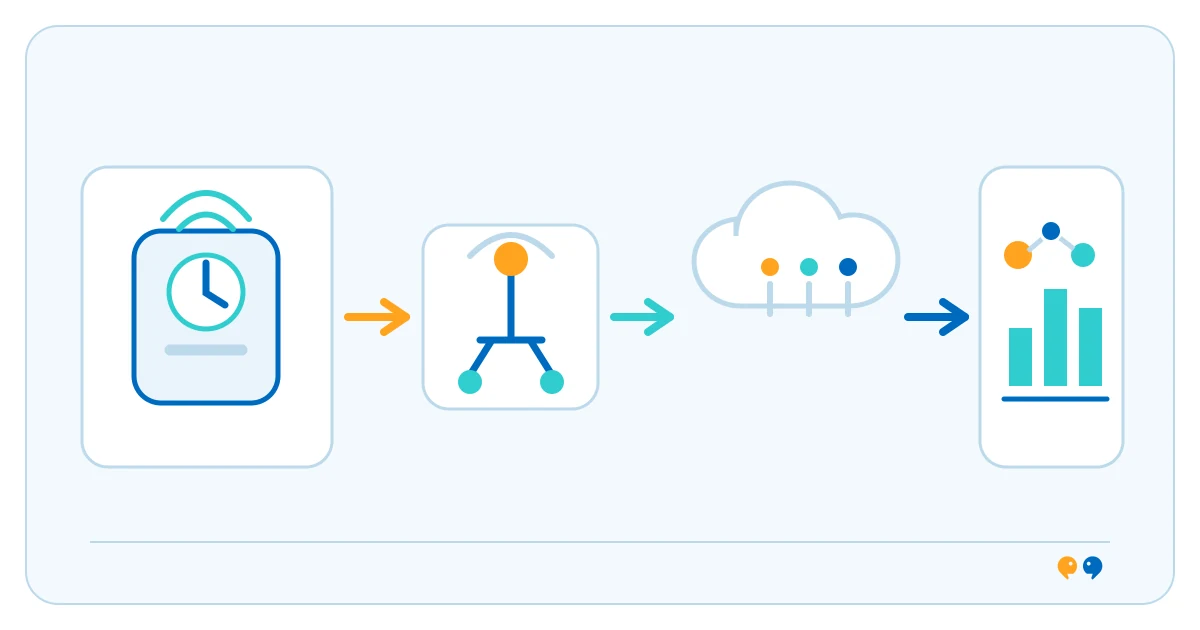
The Internet of Things (IoT) is an arrangement of connected physical or virtual things that can be identified and exchange information through communication technologies. A device may include communication, sensing, actuation, storage or processing capabilities, depending on its role. ITU-T’s Y.2069 recommendation sets out terms and definitions for IoT.
How an IoT system works
A device or sensor observes a condition, such as temperature or movement, and sends a reading through a local gateway or network. An application can store the reading, display it or apply defined rules to it. Some devices can also receive a command, for example to switch a relay. The system depends on device identity, connectivity, data formats, power and an application that handles the information.
Illustrative business example
Illustrative example: A cold-storage operator could install temperature sensors that send readings to a monitoring application. A configured threshold might prompt an alert for staff to investigate. The sensor reading alone does not determine whether stock is safe; operating procedures and calibrated equipment remain relevant.
IoT and AIoT
IoT describes connected things and the communication around them. AIoT refers to adding AI methods to some part of an IoT system, such as analysing collected readings. AI is not required for a device to be part of IoT, and adding AI does not remove the need to validate device data. Learn about data pipelines for device information and system integration.
Limits and responsibilities
Connectivity does not guarantee reliable readings, consistent interfaces or secure operation. Devices can lose network access, need maintenance or report inaccurate values. Decide who installs and updates them, how data is protected, how long it is kept and who responds to alerts. Check that devices and applications can work together before relying on a particular reading or action.
For a service-focused overview, see technine.io’s AIoT and connected-device service.
Frequently asked questions
Does every IoT device need a sensor?
No. Devices may communicate or act on commands without sensing their surroundings. Capabilities depend on the device’s purpose.
Is IoT the same as AIoT?
No. IoT concerns connected things and their communication. AIoT adds AI capabilities to part of an IoT system; not every IoT use case needs AI.
Does connecting a device make its data reliable?
No. Connectivity moves information. Teams still need to validate device identity, readings, calibration, timestamps and the handling of missing or delayed data.
Primary source: ITU-T Recommendation Y.2069: Terms and definitions for the Internet of Things