
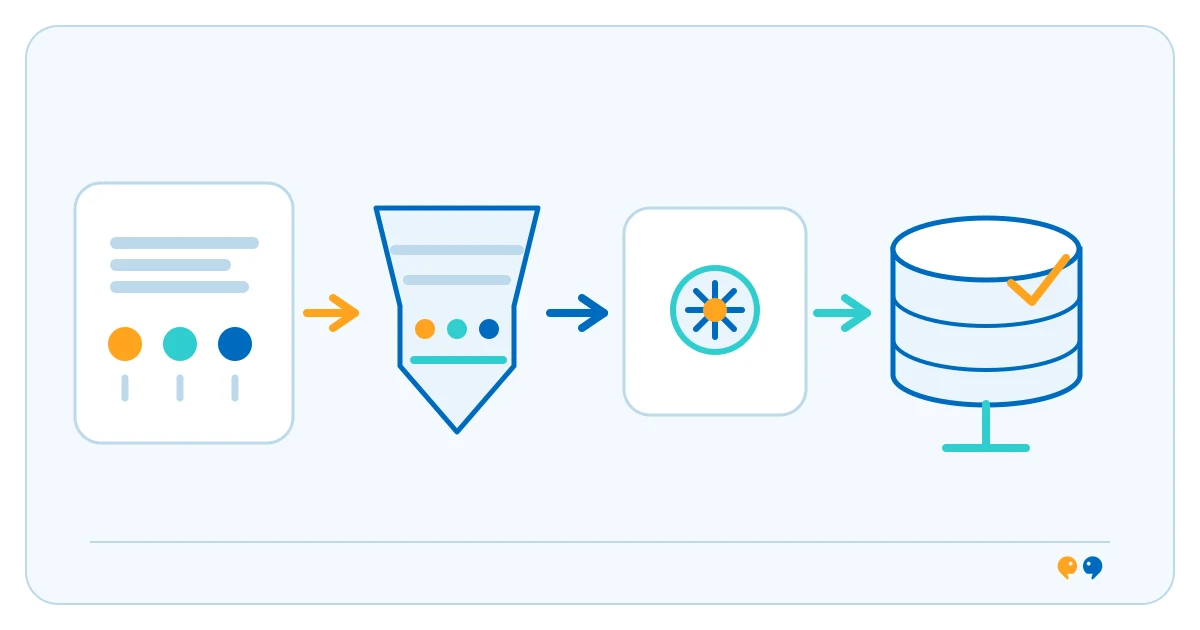
A data pipeline is a repeatable series of steps that collects or moves data, processes it and delivers it to a destination. Steps may include validation, filtering, joining, reformatting or aggregation. The destination might be a reporting store, analytics tool or another application. AWS describes a data pipeline as processing steps that prepare enterprise data for analysis, though pipelines can serve operational purposes too.
How a data pipeline works
A pipeline reads from one or more sources, applies defined transformations and writes the result to a destination. It may run on a schedule as a batch, or handle events as a stream. Teams define what to do when a source is late, a record fails validation or a run stops midway. The AWS overview of data pipelines discusses pipeline components, batch and streaming patterns, and the relationship to ETL.
Illustrative business example
Illustrative example: An operations report could combine service visits from a scheduling system with parts usage from an inventory system. A pipeline maps dates and identifiers into agreed formats, flags unmatched records and loads the prepared data for reporting. Staff still need to know which source is authoritative when values conflict.
Pipeline, ETL and system integration
ETL means extract, transform and load; it is one common approach for moving and preparing data. Other pipelines may load raw data first and transform it later, or stream changes continuously. A system integration often supports operational exchange between applications, while an analytics pipeline commonly prepares data for analysis. The boundaries can overlap. Read about system integration and RAG data sources.
Limits and operating needs
A pipeline cannot make inconsistent source data meaningful without clear rules. A successful run can still produce misleading output if fields are mapped incorrectly, definitions differ or records are missing. Protect sensitive data, validate important fields, monitor freshness and failed runs, and assign someone to investigate issues. Batch and streaming choices affect how quickly data arrives and how the pipeline is operated.
For a service-focused overview, see technine.io’s data analytics and AI-ready data service.
Frequently asked questions
Is every data pipeline an ETL pipeline?
No. ETL is one pipeline approach. Some designs load data before transforming it, stream events or combine other steps.
What is the difference between batch and streaming?
Batch processes a collected group of records at intervals. Streaming processes incoming events continuously or in small increments. The choice depends on how current the data needs to be and the operational requirements.
Does a pipeline guarantee clean data?
No. It can apply validation and transformation rules, but those rules need to reflect agreed definitions. Monitor exceptions and check whether the source data is complete and trustworthy.
Primary source: AWS: What is a data pipeline?