
Before Property Management AI Goes Live: Fix Maintenance, Inspection and Tenant Workflows
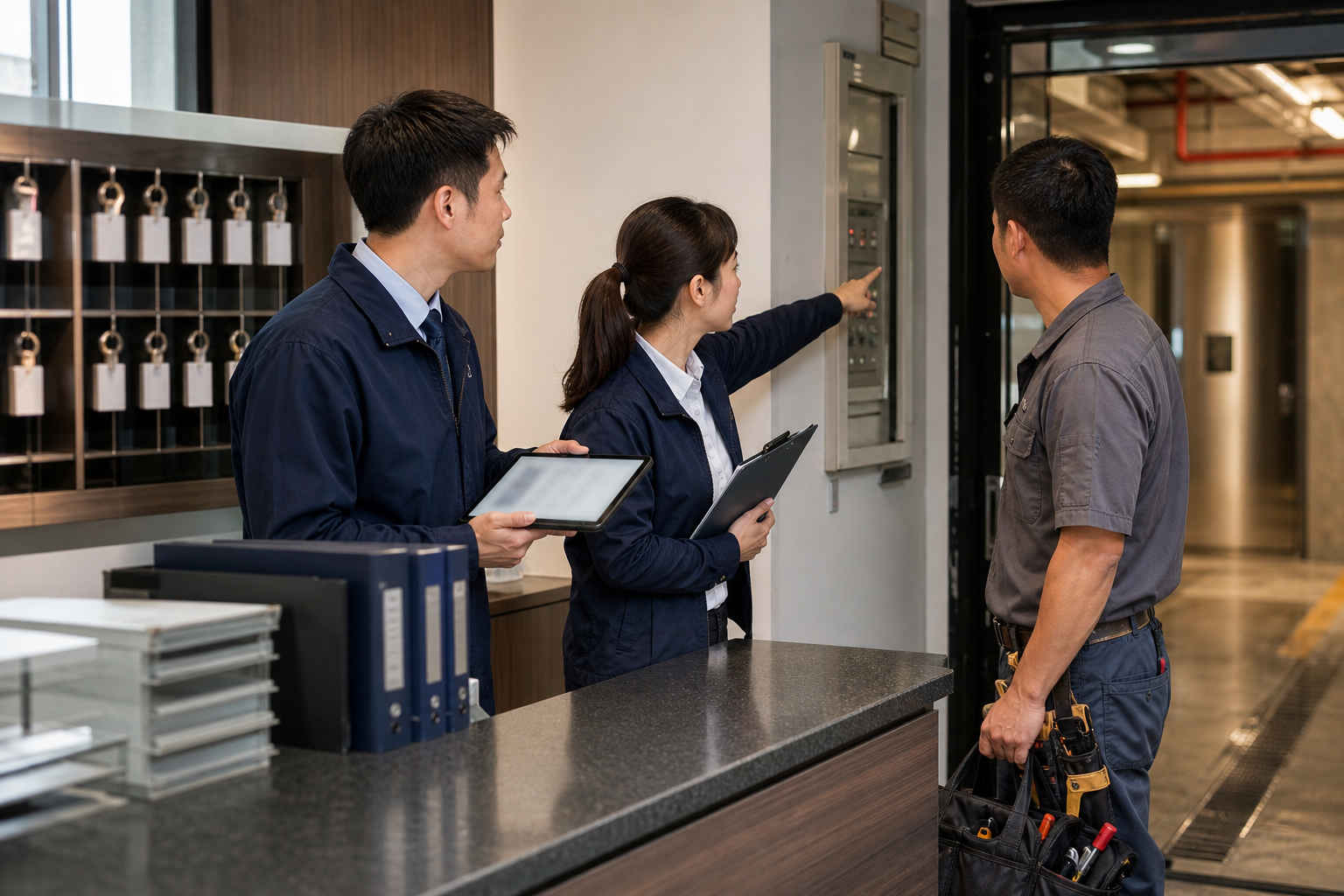
A building management office starts the morning with dozens of maintenance requests. A resident reports a lift noise. A shop tenant asks for an air-conditioning repair update. A security guard uploads photos of water seepage in a common area. A contractor replies in a separate group chat with an expected arrival time. Management wants AI to classify, summarise and remind the team, but one practical problem appears quickly: if work orders, photos, contractors, tenant data and approval records are still scattered, AI becomes another tool that staff must manage.
That is why Hong Kong’s recent PropTech activity matters. On July 28, 2026, Cyberport listed a Hong Kong Housing Society (HKHS) and Cyberport PropTech Proof-of-Concept Programme event around applying AI in construction and property management. Separately, the Smart QS Hackathon 2026, co-organised by the Housing Bureau, the Hong Kong Housing Authority, the University of Hong Kong and Cyberport, held its briefing on July 29, 2026. The programme focuses on practical AI applications for quantity surveying (QS), including construction cost management, tendering, contract management, contract advisory and payment valuation.
For property management companies, facilities teams and construction operations teams, the question is not simply whether they have AI. The real question is: which workflows are ready for AI to read, classify, alert and write back into the operating system?
A successful PoC does not mean operations are ready
A proof of concept usually chooses a clear scenario: classifying maintenance photos, summarising inspection reports, comparing quotation documents, or helping QS teams prepare payment valuation data. These scenarios are easy to demonstrate and their value is visible. Daily operations are more complicated. Who may see resident data? Which photos can be uploaded? Is a contractor’s reply reliable? Can AI classification directly trigger dispatch? Who reviews mistakes?
Example: a property management team can start with a pilot for common-area maintenance. AI only classifies photos and descriptions into plumbing, electrical, lift, cleaning or security categories, then suggests priority. Dispatching, resident notification, cost confirmation and case closure still require staff or supervisor approval. AI handles the sorting work first, rather than taking over accountability.
The first workflow to fix is the maintenance work order
The most practical AI workflow in property management is often not a large smart city dashboard. It is a reliable maintenance work order. The work order should capture the report source, location, photos, urgency, resident or tenant contact channel, contractor, expected arrival time, cost approval, completion evidence and customer response.
If these details sit across WhatsApp, Excel, email and paper forms, AI may generate a polished summary but the system cannot know which version is current. If the work order system has clear fields, AI can do three useful jobs: classify cases, flag overdue items and prepare a daily exception list for supervisors.
Example: after a resident submits a photo of ceiling water leakage, the system creates a work order. AI suggests high priority based on the location, description and past records. A supervisor confirms and assigns it to a plumbing contractor. After the contractor uploads completion photos, AI summarises the case, while staff still confirm whether it can be closed.
The second workflow is inspection and facilities data
Inspection work usually has two pain points: frontline staff take too long to complete forms, and management cannot see patterns. AI can help convert inspection photos, voice notes and sensor data into reports, but equipment, locations and owners need consistent identifiers first.
For properties with Internet of Things (IoT) devices, lifts, pump rooms, air-conditioning, access control, car parks, energy systems and leakage sensors may be managed by different vendors. Each system may have its own admin portal. Without a unified asset list and event rules, AI sees fragments rather than an operating view.
Example: a commercial building can create an equipment master for high-risk assets: equipment ID, floor location, maintenance contractor, service cycle, common fault types, related sensors and emergency contact. When a sensor raises an alert, AI can compare past work orders and maintenance records and tell staff, “This is not a one-off alert; there were three similar incidents in the past 30 days.” The engineering supervisor then decides whether to escalate.
The third workflow is tenant and resident service
Many AI service demos can answer common questions. In property management, however, answering is rarely the end of the process. A tenant asking about an air-conditioning repair needs more than a reply. A resident asking about a complaint needs case status. A shop tenant applying for renovation approval involves documents, deposit, insurance, contractor details and approval timing.
Tenant service AI should therefore connect not only to FAQs, but also to customer relationship management (CRM), work orders, document repositories and approval records. More importantly, the team must define which replies can be sent automatically and which require human review.
Example: a mall tenant asks whether a signboard repair application has been approved. AI can read the application status and missing documents, then prepare an internal draft: “The contractor insurance document is still missing, and the tenant has been asked to resubmit.” But rejection messages, fees, complaint responses or liability-related wording should be approved by a customer service supervisor before being sent.
The fourth workflow is contractor handoff and approval
Property and construction work rarely belongs to one team. Building management, engineering, security, cleaning, maintenance contractors, consultants and tenants exchange information every day. For AI to be useful, it cannot only read internal records. It must also support outsourced replies, arrival logs, quotations, completion photos and approval workflows.
This requires permission design. Contractors should not see unrelated resident data. Frontline staff should not change cost approvals directly. AI should not treat a contractor’s statement as fact before verification.
Example: after a contractor finishes a repair, they upload photos and a short note. AI checks whether required fields are missing, such as completion time, photos, materials and follow-up requirement. If information is incomplete, the system returns it to the contractor. If complete, it goes to management staff for confirmation, then moves to payment or closure.
The fifth workflow is QS, contracts and payment valuation
The Smart QS Hackathon 2026 specifically refers to QS workflows, including construction cost management, tendering and contract management, with assigned challenges for contract advisory and payment valuation. This is relevant beyond hackathon participants. Construction, maintenance and property management teams all deal with the same practical issue: AI can organise and compare documents, but it should not bypass commercial judgment and approval.
Payment valuation, variation orders, quotation comparison and contract clauses involve money, responsibility and dispute risk. AI can extract fields, identify missing evidence, compare versions and prepare summaries. Final confirmation should still sit with the QS, engineering supervisor, finance or administration team.
Example: a maintenance contractor submits a monthly statement. AI compares it with completed work orders, arrival photos and contract rates. It flags “three work orders have no completion evidence” or “one charged item is not covered by the contract schedule.” Finance no longer starts from a blank spreadsheet, but the payment approval still belongs to a named approver.
The sixth workflow is spatial data, BIM and system integration
Cyberport’s Proof-of-Concept Programme with the Development Bureau’s Spatial Data Office also encourages technology ventures to use AI, IoT, geospatial analytics and Building Information Modelling (BIM) to create digital solutions. For property operations, the value is not in the terminology. The value is turning location into usable operating data.
Maintenance location, equipment location, tenant area, floor plans, fire routes, car parks, energy zones and construction boundaries need to be recorded consistently before AI can help analyse repeated faults, plan inspection routes, estimate affected areas and support management reporting.
Example: if several tenants on the same floor repeatedly report weak air-conditioning, the system should not show only separate work orders. It should bring location, time, equipment, sensor readings and past service records together, then alert engineering staff that the issue may relate to one air-conditioning zone or asset group.
A 30-day starter checklist
Week one: choose one workflow. Do not try to transform the entire portfolio at once. Common-area maintenance or tenant service enquiries are good starting points because the data sources and business value are relatively clear.
Week two: define fields and owners. Every work order should have source, location, photo, category, priority, owner, contractor, status, approver and completion evidence.
Week three: define what AI may do. Keep AI to classification, summarisation, reminders, missing-field checks and report drafts first. Do not let it directly approve payments, reject applications or send high-risk responses.
Week four: run exception drills. Test what happens when there is water leakage, lift failure, tenant complaint, contractor delay, payment dispute or data error. The team should know how the system escalates, records and returns the case to human handling.
PropTech works when operating data is connected
AI, IoT, BIM and spatial data can all make property management and construction workflows more intelligent. But the foundation is still work orders, permissions, approvals, contractor handoff and data write-back. Without those, a strong PoC may never become a durable operating workflow.
If your team is preparing to move PropTech AI from demonstration into a real property or construction process, start with one high-frequency workflow, define the data sources, approval points and write-back location, then assess what AI, IoT or cloud integration support is actually needed.
Putting this into practice
Connect maintenance requests, contractor updates and resident services with clear permissions and approval records.