

AI Vendor Geopolitics Is Now an Operational Risk for Hong Kong Businesses
Update, 5 September 2026: Anthropic reported that the June export controls were lifted on 30 June and announced restored access to Fable 5 and Mythos 5 on 1 July. The article below preserves the discussion published on 13 June. Read Anthropic’s update.
If your customer service, reporting, software maintenance, or security checks already depend on a specific AI model, the biggest problem may not be a wrong answer. It may be that the model is suddenly unavailable tomorrow. In June 2026, several international reports said the U.S. government had applied export controls to Anthropic's Fable 5 and Mythos 5 models, after which Anthropic suspended access to those models.
For Hong Kong companies, the lesson is not simply about one AI vendor or one U.S. policy dispute. AI vendor geopolitical operational risk is becoming a real business continuity issue. Until recently, many companies chose AI tools by comparing features, price, speed, and privacy terms. Now they also need to ask: if a vendor restricts service because of policy, compliance, or geopolitical pressure, which business workflows stop first?
What happened?
Axios reported that U.S. Commerce Secretary Howard Lutnick told Anthropic that exports, re-exports, or transfers of Mythos 5 and Fable 5 would require a license, including transfers to foreign persons inside the United States. The Wall Street Journal reported that the scope of the restriction led Anthropic to suspend access to the two models for all customers to reduce compliance risk.
The Financial Times added that the government's concern was linked to a jailbreak vulnerability and cybersecurity risks to critical infrastructure. Business Insider had reported earlier that Fable 5 was Anthropic's public Mythos-class model with safeguards, while Mythos 5 was the less restricted version intended for trusted cybersecurity users.
The details may still evolve as official documents and company statements emerge. But companies do not need to wait for every legal detail before acting. If a vendor's core AI model can be restricted overnight, AI vendor risk belongs in the business continuity plan.
Why should Hong Kong companies care?
Your company may not use Fable 5 or Mythos 5 directly. But many teams already rely on U.S. AI vendors for customer support drafts, sales emails, document summaries, code changes, meeting notes, compliance screening, vulnerability analysis, and management reports. These tools may look like ordinary SaaS subscriptions. In practice, they may already participate in customer service, delivery, security, and internal decisions.
Example: a software company uses an AI coding agent to help maintain client systems. If the model is suddenly downgraded or disabled, the team may not stop entirely, but bug-fix time, testing coverage, and delivery rhythm may suffer. If the company has service-level commitments, this AI dependency has already become a service risk.
Example: a professional services firm uses AI to summarize contracts and client meetings. If the main AI tool is restricted by region, the team may switch to another platform, but prompts, document formats, permissions, and approval records may not move cleanly. Switching AI tools is not always as simple as logging into another website.
First check: which workflows depend on a specific model?
Many businesses underestimate AI dependency because AI adoption often happens without a formal project. There may be no procurement meeting, no IT ticket, and no architecture diagram. Staff are already using AI in daily work.
Start with a simple inventory:
Workflow | What AI does today | What happens if it stops | Risk level
Customer support | Classifies, drafts replies, summarizes complaints | Replies slow down, but manual handling is possible | Medium
Sales follow-up | Drafts emails, organizes CRM notes | Follow-up cadence drops | Medium
Software maintenance | Generates patches, reviews code, writes tests | Delivery delays and technical risk increase | High
Cybersecurity | Analyzes vulnerabilities and remediation options | Patch decisions slow down | High
Compliance documents | Summarizes clauses and classifies files | More manual review is needed | Medium to high
The table does not need to be perfect at first. The point is to turn "everyone uses a bit of AI" into manageable operational data. Once leaders know which workflows are affected, they can decide whether model fallback, internal tooling, or stronger vendor commitments are needed.
Second check: fallback is not just another AI account
Some companies hear "fallback" and assume that buying a second AI subscription is enough. In reality, AI fallback depends on three things: input data, work rules, and output write-back.
Customer support example: if the primary model reads CRM data, order status, and WhatsApp messages before drafting a reply, the fallback model needs the same permission model, prompt rules, sensitive-data masking, and CRM write-back process. Otherwise, staff may have to copy data manually when switching tools, increasing risk instead of reducing it.
Software example: if an AI coding agent connects to a Git repository, issue tracker, and CI/CD system, the fallback is not just another chatbot. The company needs to define which repositories can be read, whether the model can only work on feature branches, how test results are stored, and who approves pull requests.
The practical goal of fallback is not to keep every workflow equally fast. It is to prevent critical work from stopping completely because one vendor changed access.
Third check: keep approvals and records in company systems
AI vendor risk becomes harder to manage when approvals and records live inside the vendor platform. If policy changes, region restrictions, account suspension, or contract termination occurs, the company may lose important context.
A safer pattern is to let AI generate suggestions while keeping key decisions inside company systems:
Customer discounts and refunds: approved in CRM or ERP
Contract terms: confirmed in document management or approval tools
System changes: recorded in issue trackers, pull requests, and CI/CD
Security remediation: recorded in asset inventory and patch tickets
Management reporting: tied to BI or data warehouse sources
For example, a logistics company may use AI to analyze a delivery delay. AI can organize the timeline and suggest a compensation approach. But whether to compensate, how much to pay, and who approved it should remain in the ticket system. Even if the AI tool disappears later, the company still knows why a decision was made.
Fourth check: ask procurement questions about region and policy risk
Traditional SaaS procurement asks about uptime, encryption, privacy terms, and price. AI procurement should add several more questions:
Can service be restricted by region, nationality, customer type, or use case?
If a model is disabled, will the vendor automatically downgrade to another model, and will users be told?
Can prompts, workflows, agent settings, and conversation records be exported?
Can enterprise data be excluded from training, and how long is it retained?
Does the vendor provide model-change, service-change, and security-incident notifications?
Does the contract clearly cover data deletion, export, and post-termination handling?
Hong Kong SMEs may not get perfect answers to every question. But if a vendor cannot answer at all, or only answers with sales-deck language, the gap should be treated as a risk.
Fifth check: build fallback for three kinds of work first
Not every AI use case needs the same level of backup. Start with three categories.
The first is customer-facing workflows such as support, quotations, booking, after-sales service, and complaints. These directly affect revenue and trust. If AI stops, there should still be manual templates, owners, and response-time targets.
The second is system delivery workflows such as app changes, website forms, internal reports, and integrations. These should retain a human development, testing, and release path. Do not let the team become fully dependent on one coding agent.
The third is risk and compliance workflows such as vulnerability analysis, document review, supplier assessment, and incident response. AI can speed up triage, but judgment and evidence should remain with people and company systems.
A simple AI continuity architecture
Companies do not need an overbuilt platform. But AI should sit inside the workflow, not own the workflow.
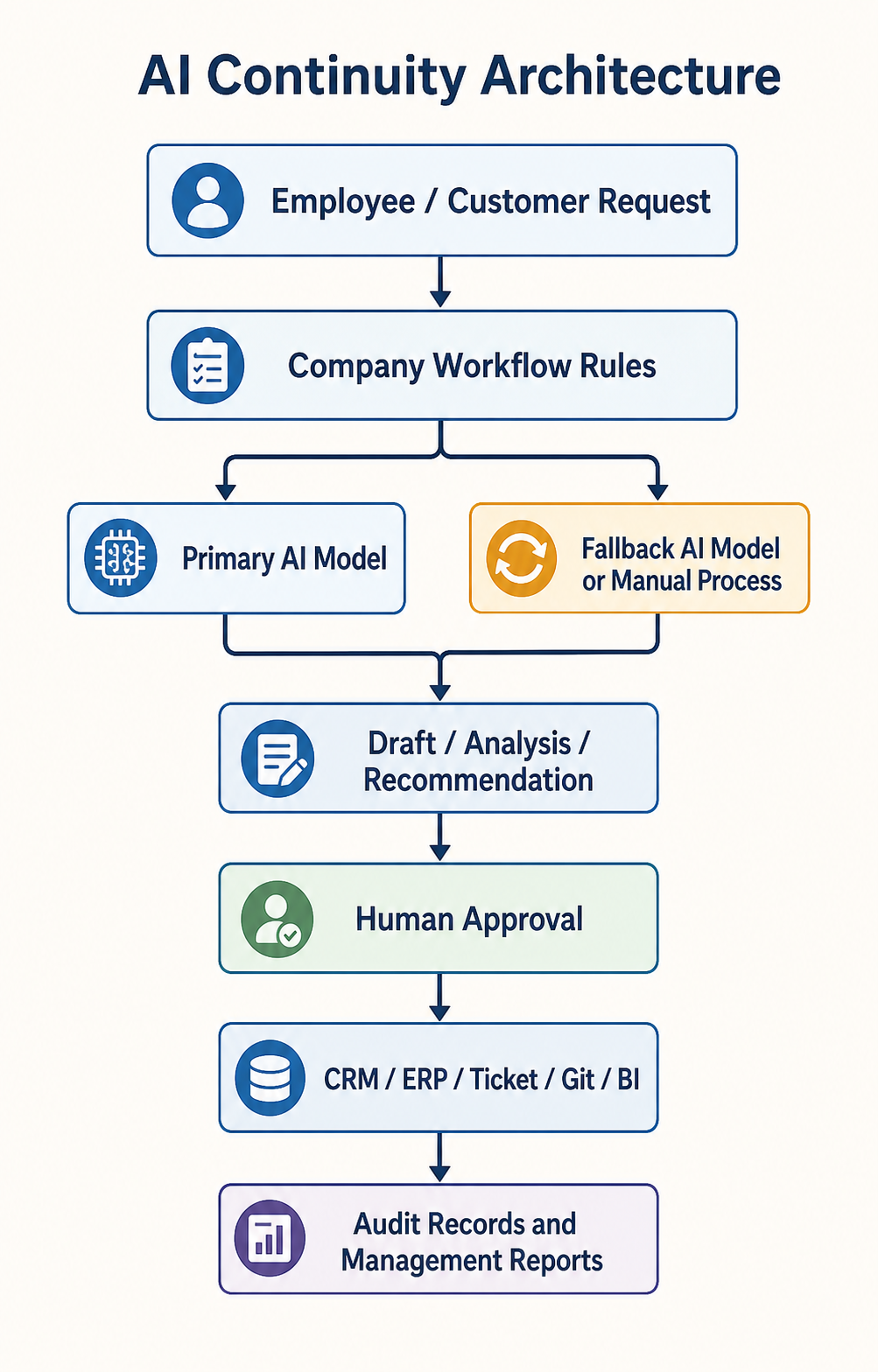
The key is that AI can be replaced, but the company's workflow, approvals, and records should not be locked inside a vendor platform. If the primary model becomes unavailable, a fallback model or manual process can continue the work. If vendor policy changes, the company still has its own data and decision records.
What to do in the next 30 days
In week one, inventory the AI tools used across departments, including personal accounts and company accounts. Ask customer service, marketing, sales, administration, finance, and development teams, not just IT.
In week two, choose the three most important AI workflows, such as customer replies, software maintenance, vulnerability analysis, or compliance summaries. Write down the primary model, input data, output destination, and approver.
In week three, design fallback for each workflow. Which model can replace the main one? Can the task be handled manually for a short period? Which templates and system records must be preserved?
In week four, update procurement and vendor review questions to include region restrictions, model substitution, data export, retention policy, and service-change notifications.
AI tools are more valuable when they are replaceable
The Fable 5 and Mythos 5 reports are a reminder that AI tools are not just feature choices. They are exposed to policy, compliance, and geopolitical risk. Hong Kong companies do not need to stop AI adoption because of one overseas news event, but they should stop treating AI as a risk-free utility.
Start with one practical question: if your most-used AI model stopped working tomorrow, which three workflows would be affected first? Those answers are the beginning of AI risk management.
Putting this into practice
Assess the task, data access and human review needed before introducing AI into an operational workflow.